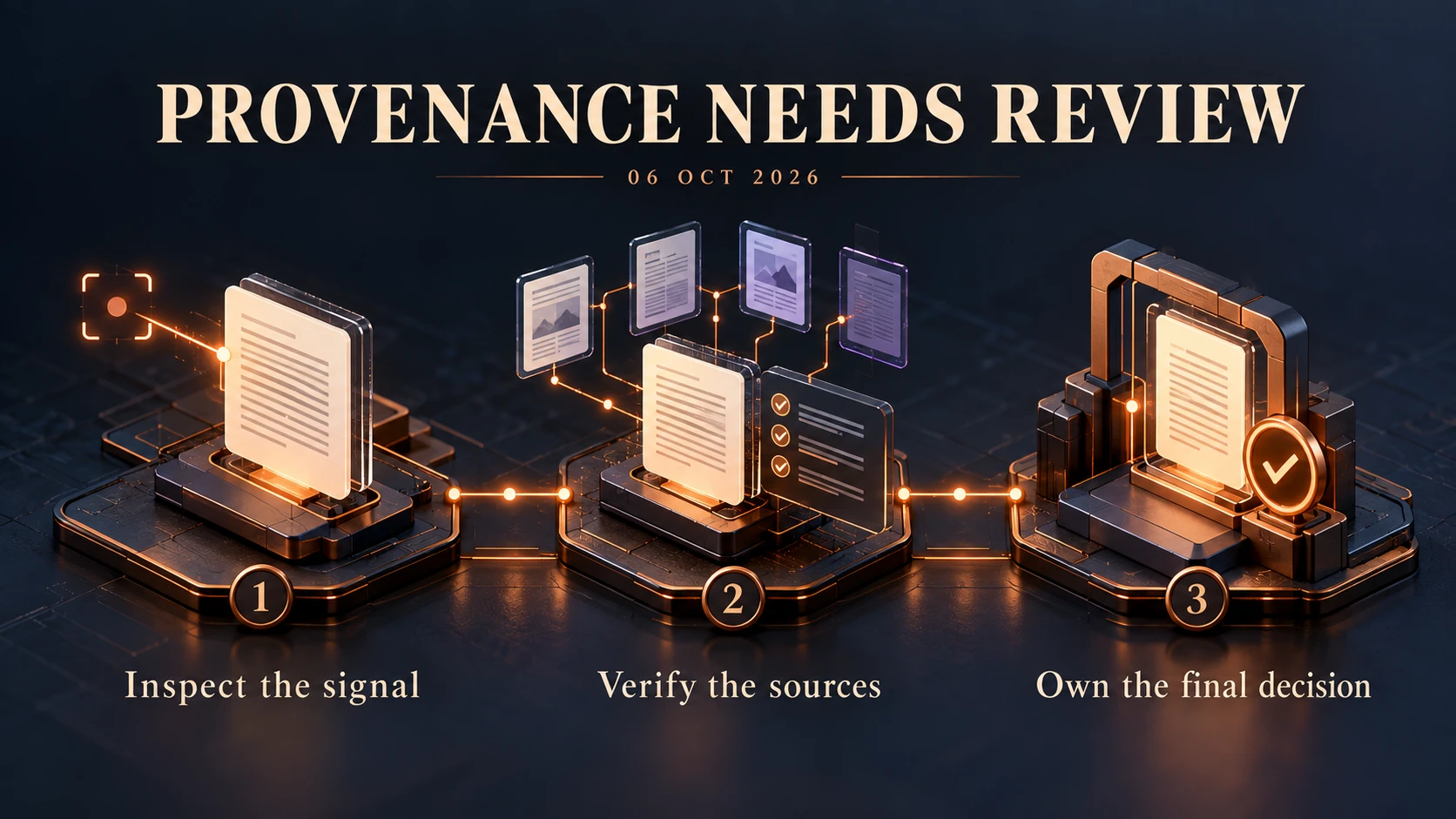
AI-generated text is moving through more workflows: drafts, support replies, research notes, documentation, and published pages. That makes it reasonable to ask where material came from. It does not make provenance detection a shortcut to truth.
OpenAI’s phased text-watermarking rollout is a useful example. The system is opt-in for selected API models and is being expanded for eligible ChatGPT and Codex users in the European Union. OpenAI is also clear about the essential limit: edits can weaken detection substantially, and a watermark cannot determine a person’s identity, ownership of the work, or factual reliability.
That limit should shape the workflow.
Three questions that should stay separate
1. Was a provenance signal detected?
A detected watermark or similar marker may mean content deserves a closer look. It does not, by itself, establish the full history of how the text was created or changed.
A non-detection also does not prove that a person wrote something without AI help. A detection does not tell you whether the text is good, harmful, copied, or correct.
2. Are the claims supported?
Fact checking is a separate job. It means preferring primary sources, confirming dates and scope, distinguishing announcements from delivered capabilities, and marking uncertainty where evidence is thin.
A polished paragraph with a provenance marker can still be wrong. An unmarked paragraph can still be carefully researched.
3. Who is accountable for the final work?
Accountability belongs in the publishing process, not in a detection score.
A durable workflow records who reviewed the draft, which sources support material claims, what disclosures are required, and who approved the final version. Those controls matter whether AI was used, disclosed, detected, or not detected.
A practical editorial flow
- Disclose relevant use according to your publication policy.
- Inspect available provenance signals as review inputs, with documented limitations. Do not treat a missing signal as proof of human-only authorship.
- Verify substantive claims against primary sources.
- Apply human editorial judgment on accuracy, framing, attribution, and potential harm.
- Record final accountability with a named reviewer or editor.
This avoids two common mistakes: treating every AI-assisted draft as untrustworthy, and treating technical provenance as a substitute for editorial responsibility.
The same pattern in software delivery
GitHub’s ReviewBench points in a similar direction for AI code review: measure quality with precision and recall rather than raw comment volume. That is useful, but an offline benchmark is still only a proxy for how a tool will behave in a real team environment.
Google Cloud’s modernization announcements emphasize assessment, planning, dependency understanding, transformations, and human approval stages. The durable pattern is not autonomous action. It is automation bounded by evidence and review.
The standard worth keeping
Provenance can help answer: What should we inspect more closely?
It cannot independently answer: Is this accurate? Is it original? Is it ethical? Who is responsible?
Those remain human and organizational decisions. A resilient editorial system uses provenance as one signal, source verification as another, and documented accountability as the final control.